

2026 Australian Salary Guide
The Aquent Australian Salary Guide features salary benchmarks for 100+ roles across marketing, creative, design, technology, and emerging AI roles.
Access the latest salary data and market insights you need to make smarter remuneration and hiring decisions in a complex and rapidly changing talent market.
Get the Guide
What's Inside Aquent's Salary Guide
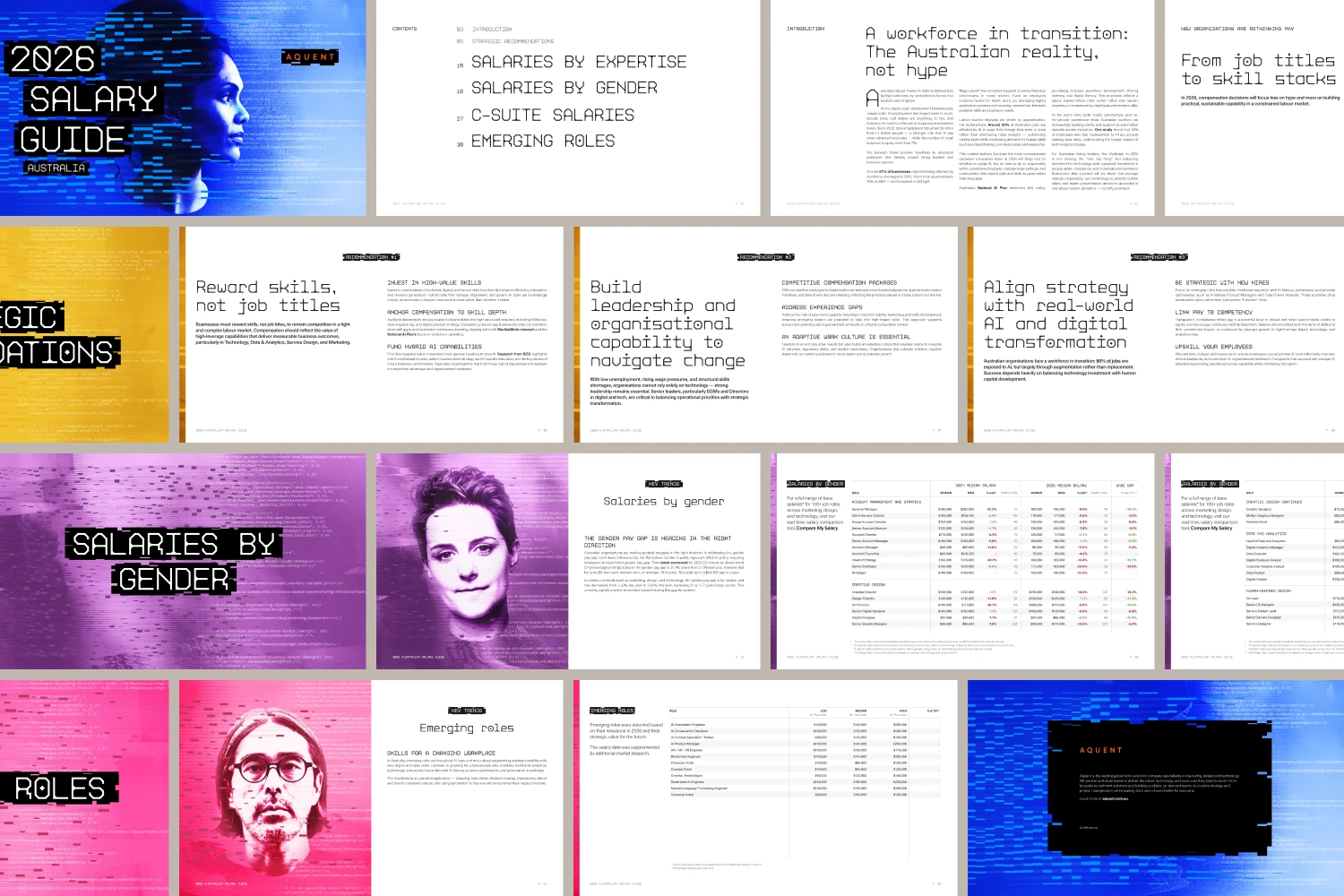
Australian Salary Guide Overview
Aquent’s 2026 Australian Salary Guide is a comprehensive resource for hiring leaders in the marketing, creative, design, and technology sectors, analysing 5,404 real-time salaries to provide statistical data on remuneration trends. Explore hiring trends and workplace insights on the current labour market, the impact of AI augmentation, the narrowing gender pay gap, and the rise of hybrid “skill stacks” over traditional job titles.
Strategic Recommendations
Get a clear blueprint to stay competitive. Prioritise pay for high-value skills, strengthen leadership and organisational capability, and make strategic decisions to best position your organisation for success.
Salaries by Expertise
Access the latest salary benchmarks in our salary guide for in-demand roles across marketing, creative, design, technology, and emerging AI roles with year-on-year growth.
Salaries by Gender
View salaries by gender in our salary guide, helping organisations to conduct thorough pay equity audits and identify any gender pay gap issues.
C-Suite Salaries
Benchmark C-Suite salaries by role and company size in our salary guide, and find out why senior leadership continues to command a premium.
Salaries by Emerging Roles
See salaries in our salary guide for Australia’s emerging and high-growth roles defining the future, including AI Product Manager, Creative Technologist, AI Automation Engineer, AI Trainer, and NLP Engineer.
Hiring or looking for work?
2026 Australian Hiring Trends & Salary Benchmarks
This year, remuneration decisions will focus less on hype and more on building practical, sustainable capability in a constrained labour market. Below are some of the standout salary and hiring trends from our 2026 Australian Salary Guide.
- The “hybrid” talent premium: Employers are prioritising “hybrid talent” capable of responsibly managing and governing AI tools and being experts in their roles.
- There is a shift toward AI orchestration roles, where humans direct strategy while AI handles execution.
- Leadership remuneration outpaces general staff: C-suite salaries are growing at 5.3% year-on-year, compared to 3.1% for directors and individual contributors. This premium reflects the critical need for leaders who can navigate digital transformation, regulatory shifts, and complex cross-functional projects.
- Gender pay gap improvement: The gender pay gap in marketing, design, and technology has narrowed to 3.56%, a significant improvement from 5.33% the previous year, signalling positive movement in these areas.
- Data and analytics drive growth: The strongest salary growth is occurring in Data and Analytics, which saw an average increase of 8.2%, more than double the overall average of 3.1%. This surge reflects businesses' reliance on data-driven decision-making and machine learning.
- Creative wages are decelerating: Salary growth in Creative and Human-Centred Design has slowed significantly (1.6% and 1.9% respectively), down sharply from previous years. This is attributed to increased talent availability and to AI automating foundational tasks.
Australia's future-facing, emerging roles

AI Automation Engineer
Automation Engineering is undergoing one of the most significant transformations in the entire tech sector. This is no longer a niche technical role; it has become the “connective tissue” of the modern enterprise. While AI Engineers build the engines, Automation Specialists build the vehicle and the roadmap. Gone are the days of strict “if-then” rules to handle repetitive tasks. This role has pivoted toward intelligent automation, where you build systems that can think, adapt, and learn.
As of early 2026, the demand for Automation Engineers in Australia continues to grow, with employers increasingly prioritising “AI proficiency” over years of experience. The median salary for an AI Automation Engineer is $140,000.
AI Product Manager
The bridge between business needs and technical reality, the AI Product Manager (AI PM) role has evolved from a niche title to one of the most critical leadership positions in tech. AI Product Managers oversee the lifecycle of an AI product, ensuring it actually solves a customer problem.
Expanding beyond a niche technical role, this role has become one of the most competitive and well-compensated specialisations in the technology sector, with employers increasingly prioritising “AI proficiency” over years of experience. The AI Product Manager is a well-paid emerging role, with a median base salary of $160,000.


Generative AI Engineer
In a workforce where 90% of roles are affected by AI, the Generative AI Engineer stands out as a critical hire for organisations funding the “AI Pivot”. It is a specialised software engineering role responsible for the lifecycle of generative models within production environments. The role focuses on the end-to-end development and integration of transformative AI technologies into reliable, production-ready tools that solve complex real-world problems.
With an emphasis on maintaining ethical standards and brand compliance, Generative AI Engineers command a median base salary of $180,000, reflecting the high market demand for talent that can navigate the structural pressures of a transitioning labour market.